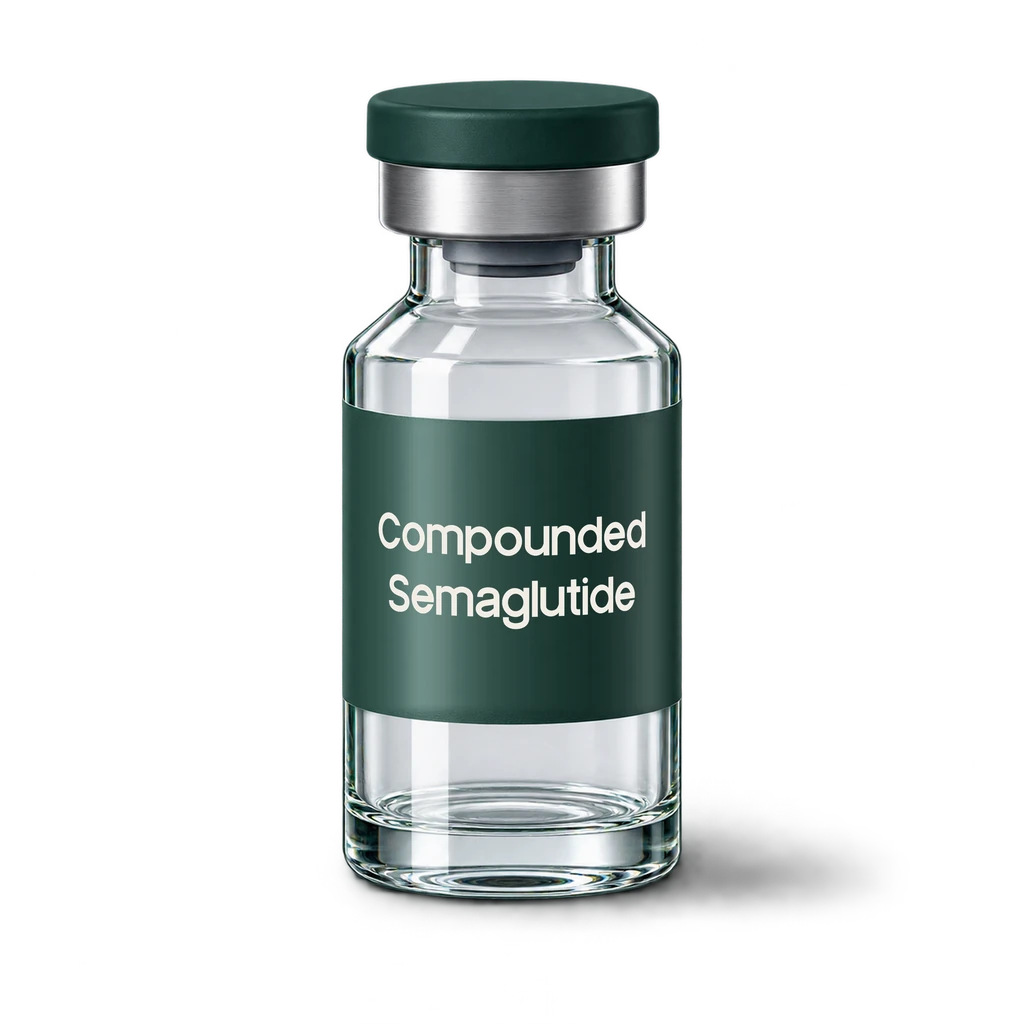
Compounded Semaglutide
from $152/moon the 12-month plan
GLP-1 prescription therapy for weight loss, reviewed by a licensed provider.
Compare plan lengths
$152/mo
$1,824 charged once today · nothing renews · you save $564
Check your eligibilityA licensed provider reviews every intake before treatment is prescribed.
How Compounded Semaglutide works
We would rather you understand the medicine than take our word for it.
It mimics a hormone you already make
After a meal your gut releases GLP-1, a hormone that tells the pancreas, the stomach and the brain that food has arrived. Semaglutide is a long-acting GLP-1 receptor agonist: it stands in for that hormone and is built to last about a week, so the signal that normally fades in minutes stays on between doses.
Drucker, Cell Metabolism, 2018 — mechanisms of action of GLP-1
It slows how fast the stomach empties
Food leaves the stomach more gradually, so a meal keeps you comfortably full for longer instead of spiking and crashing. In a controlled study of adults with obesity, semaglutide 2.4 mg slowed emptying of the first part of a meal and lowered hunger and energy intake alongside it.
It turns down appetite signalling
Acting on appetite centres in the brain, it eases hunger and the constant pull of “food noise”, so smaller portions feel like enough. In a controlled study, people on semaglutide ate about a quarter less at a free-choice meal and reported lower hunger and fewer cravings than on placebo.
Explore results reported in clinical trials
Adjust the starting weight to see a published study average in pounds. These trials studied the FDA-approved branded medicines, not compounded versions — and an average is not a prediction of your result.
Trial-average loss for your starting weight
31 lbs
Trial average · Semaglutide
Your estimated BMI
31.9
Thoughtful care in four clear steps

Medical intake
Tell us about your health history, current medications, goals, and prior treatment. This is a medical screening, not a product order.

Clinical review
A licensed clinician in your state independently decides whether treatment is appropriate. A prescription is not guaranteed.

Medication delivery
If prescribed, a licensed pharmacy prepares your medication and ships it in discreet packaging. Compounded medications are not FDA-approved.

Ongoing care
Use your portal for check-ins, dose questions, side effects, refills, and treatment changes. Your clinician can adjust or stop treatment based on your health and response.
The expanding universe of GLP-1 therapies.
The molecules differ in price, in effect, and in how much study sits behind them. Here is how the class compares, including the ones we do not dispense.
| Semaglutide | Tirzepatide | Retatrutide | |
|---|---|---|---|
| Mechanism | GLP-1 receptor agonist | GIP and GLP-1 receptor agonist | Triple GLP-1 / GIP / glucagon agonist |
| Average loss in branded-drug trials | 14.9% at 68 wks | 22.5% at 72 wks | 24.2% at 48 wks · phase 2 |
| Dosing | Once weekly, subcutaneous | Once weekly, subcutaneous | Not established outside trials |
| Common side effects | Nausea, constipation, diarrhea, fatigue (most often during dose increases) | Nausea, diarrhea, vomiting, constipation (most often during dose increases) | Gastrointestinal effects reported in trials |
| Regulatory status | Compounded under 503A — not FDA-approved | Compounded under 503A — not FDA-approved | Investigational — not available |
| Starting price | from $152/mo 12-mo plan | from $232/mo 12-mo plan | — |
| Check your eligibility | View Tirzepatide | Research only — not FDA-approved and not offered by Halwel. Read the explainer |
What changes
The outcomes measured in trials, each with its source.
About 15% average weight loss
STEP 1 included 1,961 adults with overweight or obesity. After 68 weeks, average weight loss with weekly semaglutide 2.4 mg was 14.9%, compared with 2.4% with placebo.
What to keep in mind: Results vary, and weight regain is common after treatment stops.
STEP 1, New England Journal of Medicine, 202120% lower cardiovascular risk
SELECT followed 17,604 adults with overweight or obesity who already had cardiovascular disease. Heart attack, stroke, or cardiovascular death occurred in 6.5% of the semaglutide group and 8.0% of the placebo group — a 20% relative reduction.
What to keep in mind: This study involved people who already had cardiovascular disease. It does not establish the same benefit for everyone taking semaglutide.
SELECT, New England Journal of Medicine, 2023Less hunger and fewer cravings
A 12-week study followed 30 adults with obesity. People taking semaglutide ate 24% less at a test meal and reported less hunger and fewer cravings than people taking placebo.
What to keep in mind: This was a small, short study. Appetite changes vary from person to person.
Blundell et al., Diabetes, Obesity and Metabolism, 2017Better physical functioning
STEP 1 included 1,961 adults with overweight or obesity. After 68 weeks, people taking semaglutide 2.4 mg reported greater improvement on a physical-functioning questionnaire than people taking placebo.
What to keep in mind: This was a patient-reported measure, not a direct test of strength, fitness, or energy.
STEP 1, New England Journal of Medicine, 2021Compounded Semaglutide questions
What patients ask most before starting. If yours isn't here, your clinician answers it during review.
Compounded Semaglutide is a once-weekly injection you give yourself at home, under the skin, with a fine, pre-measured needle. Most patients describe it as quick and nearly painless. Your kit arrives with everything you need, and your care team walks you through your first dose.
The most common effects are mild digestive symptoms: nausea, constipation, or reflux, usually early on and easing as your body adjusts. Starting at a low dose and stepping up gradually keeps them manageable for most people. Serious reactions are uncommon; your provider reviews your history before prescribing and stays available if anything comes up.
If a licensed provider decides this treatment isn't right for you, you are not charged. Where appropriate, your provider will suggest a safer alternative or a next step.
No insurance is needed. Compounded Semaglutide is one flat cash price that covers your medication, provider consultations, and shipping, with no membership fee. It's typically HSA/FSA eligible, so you can often pay with pre-tax dollars.


When you’re ready, begin with a short medical intake.
A licensed clinician will review your health and decide whether treatment is appropriate.